

MeerTech Ltd
Operating systems for the infrastructure that powers and feeds Africa.
We build the software layer for energy, climate, agriculture, health and public sector systems: offline first, auditable, and explicit about what the data does not know.
Fig 01 · Field to decision
Hover any stage of the operating layer to read what it does.
SectorsEnergy · Climate · Agriculture · Health · Public sector
Operating modeCapture · Verify · Compute · Report
PostureOffline first · Deny by default · Append only
BaseAbuja, Federal Capital Territory, Nigeria
01Thesis
The constraint is not intelligence. It is the field.
Models improve every quarter. What does not improve is the signal at a rural mini-grid site, the meter with no conductor specification on file, or the advisory written in a language the farmer does not read.
MeerTech builds for those conditions first, because a system that fails there was never an operating system.

Distributed assets, intermittent power, incomplete records, and a decision that cannot wait for a sync. These are the operating conditions, not the edge cases.
02Doctrine
Six constraints every system is engineered against.
They are not preferences. Each one is enforced in the database, not left to application code.
Offline first
Capture continues without a network. Sync is a design assumption, not a recovery path.
Append only
Nothing is edited in place. Corrections are new entries that reference what they correct.
No fabricated data
Where a required input is missing the system reports the absence and its reason. The database refuses the write.
Bounded AI
Model outputs run inside a deterministic envelope with a defined failure mode.
Double entry
Money moves through ledgers with idempotency keys, so a retry can never double post.
Deny by default
Access is refused unless explicitly granted, enforced at the row rather than the endpoint.
03Applied AI
Fig 02 · The AI envelope
Schematic. No measured values are shown.
AI where it earns its place.
Solar resource and yield forecasting, crop disease classification, inference over incomplete telemetry. Each one is specific, testable, and held to a baseline.
- Held to
- A forecast is a capability only once it beats persistence on real data.
- Published with
- Its error, its confidence, and the record it was derived from.
- Never
- A number with no physical basis, presented as though it had one.
04Sectors
Five sectors. One engineering approach.
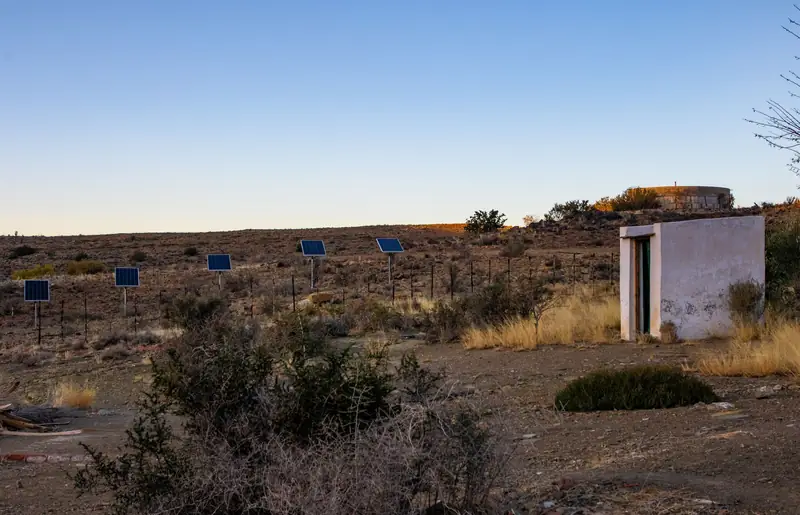
Energy and grid
Mini-grid operations, metering integrity, field workforce systems and last-mile energy payments.

Climate and renewables
Forecasting, storage performance and loss attribution for solar and storage assets.

Agriculture
Advisory in local languages, offline field capture and GIS decision support for state agencies.

Health systems
Offline-first capture, auditable records and supply tracking for operations under constraint.

Public sector data
National analytics infrastructure and field verification with lineage and immutable audit.

All solutions
The doctrine does not change between sectors. The failure modes do.
05Field conditions
A device offline for eleven days is not an edge case.
It syncs the way a device offline for eleven seconds does: the same reconciliation, the same audit chain, the same refusal to overwrite newer truth with older data.
Fig 03 · Capture and reconciliation
Schematic.
06Evidence
Systems a client is running in production.
Grouped by deployment status, and never upgraded ahead of the facts.
01
MSIV
DeployedOffline-first inventory management for a mini-grid operator, with scanner and label printer integration.
02Agricultural intelligence platform
DeployedCrop disease detection and local language advisory for a state government client in Northern Nigeria.
03NMAS
DeployedNational analytics infrastructure for the National Bureau of Statistics, with methodological lineage.
04AditusOS
BuiltThe operating layer for solar mini-grid developers. Complete and tested, awaiting its first operator deployment.

Eleven notes on building systems that report what they do not know.
Read the field notes